

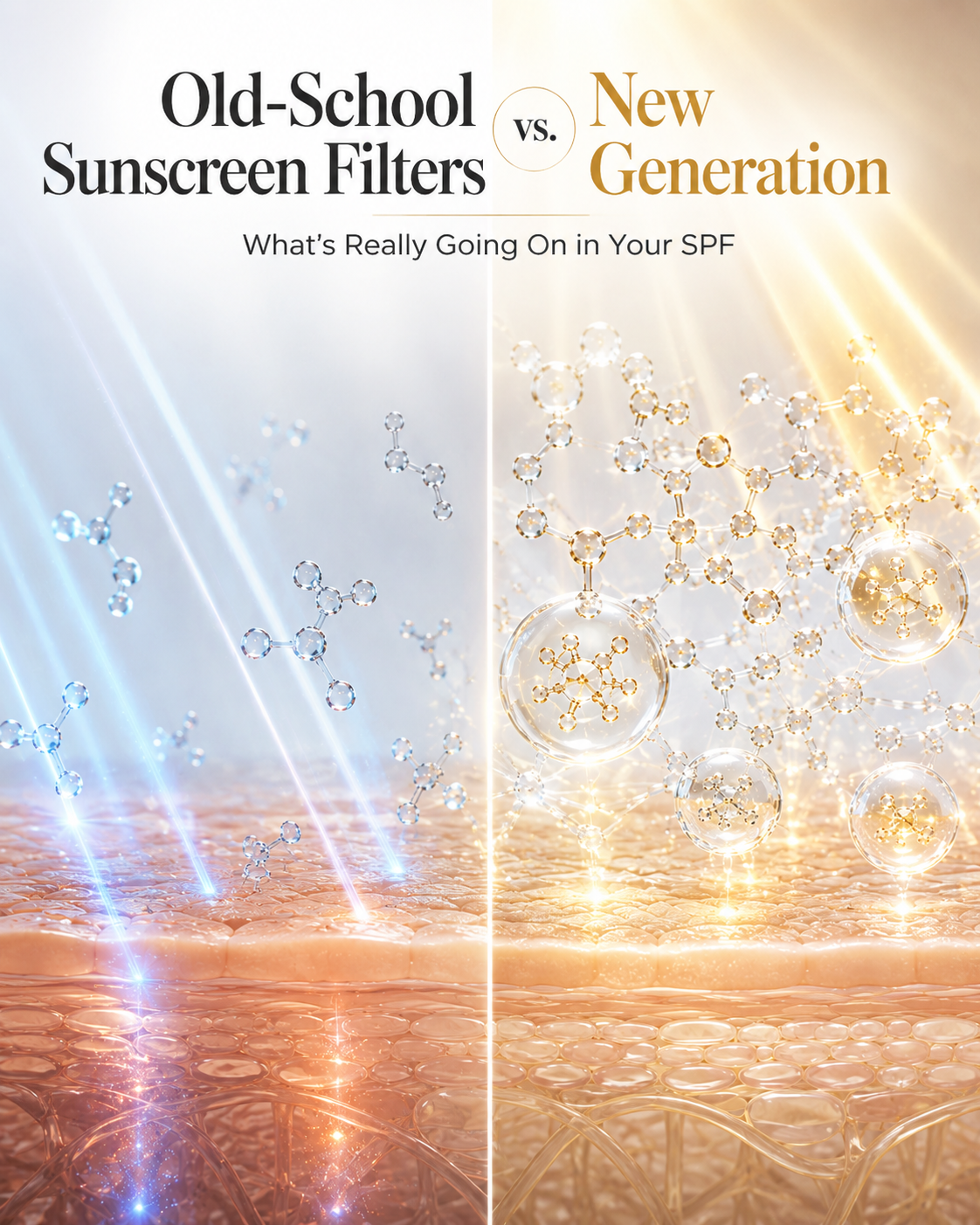
Sunscreen ingredient lists have quietly split into two camps: an older generation of UV filters that have been around for decades, and a newer generation engineered to fix their weak spots. Neither camp fails at blocking UV — the difference is in how each behaves once it’s on your skin.
The classic lineup — octocrylene, octinoxate, oxybenzone, homosalate, octisalate, and avobenzone — is built from small, simple molecules.
That small size made them easy to formulate decades ago, but it’s also their biggest liability, for three reasons.
First, several of them are photo-unstable: avobenzone, arguably the best UVA filter around, can lose roughly half its effectiveness within an hour of sun exposure if left unprotected.
Second, oxybenzone, octinoxate, and homosalate are small enough to slip through skin into the bloodstream, where they’ve been detected at levels researchers are studying for hormonal activity.
Third, oxybenzone and octocrylene have been linked to coral bleaching, which is why both are now banned in a growing number of marine reserves. Octocrylene has one more quirk: research from 2021 found that over time — even in a sealed bottle — it can slowly break down into benzophenone, a compound classified as a possible carcinogen. The longer a product sits on a shelf, the more benzophenone it may accumulate.

None of that makes an old filter automatically unsafe — it depends on the rest of the formula. Avobenzone rarely works alone: newer stabilizers like Tinosorb S, Uvinul A Plus, and Mexoryl act as a shield, absorbing excess solar energy so it can stay active for hours; octocrylene does a similar job within its shelf life; and “sacrificial” stabilizers such as ethylhexyl methoxycrylene degrade in avobenzone’s place. Separately, newer filters like Tinosorb M and Mexoryl 400 solve the penetration problem simply by being too large to pass through skin — like trying to push a beach ball through a kitchen sieve. Microencapsulation takes this further, wrapping an older filter such as octinoxate in a liposome or silicone shell so it never touches skin directly and releases protection gradually.
At the shelf, that translates into a quick checklist. If avobenzone sits near the top of the ingredient list, look for octocrylene, a Tinosorb-type ingredient, or ethylhexyl methoxycrylene nearby — that’s a properly stabilized formula, provided the product isn’t near its expiration date. If you see oxybenzone or octinoxate with no mention of encapsulation, it’s worth a second look, since modern alternatives now offer comparable protection without the same baggage.

Good sunscreen formulation today is less about blacklisting ingredients and more about pairing them well: using time-tested filters where they still make sense, phasing them out where the risk outweighs the benefit, and building formulas where each component supports the others. Understanding what’s in the bottle isn’t a reason to worry — it’s what lets you stop reading labels with anxiety and just enjoy the protection.
